
She'd Need 823,045 YouTube Views Per Month to Make $5,000 (Here's What I Recommended Instead)
The 4-Step Calculation That Shows You Which Variable Actually Matters


I pulled up a spreadsheet mid-coaching call and started typing.
Monthly goal: $5,000.
Product price: $27.
Conversion rate from lead magnet: 15%.
Opt-in page conversion: 15%.
Click-through rate from YouTube: 1%.
I hit enter on the final calculation.
823,045 YouTube views per month.
The woman on the other end went quiet.
She was getting maybe a few hundred views per video.
She could see it: the gap between her revenue goal and her current business model wasn’t small. It was a canyon.
She needed 823,045 YouTube views per month to hit $5,000 selling a $27 sewing guide.
This is the calculation most solopreneurs never run.
So they hustle harder, post more... and wonder why nothing changes.
The problem isn’t effort. It’s that the math doesn’t work.
The 4-Step Diagnostic
Here’s how I walked her through it. You can do this for your own business right now.
It just takes a few minutes.
Step 1: Calculate your monthly sales target
Monthly goal ÷ product price = sales needed per month
For her: $5,000 ÷ $27 = 185 sales per month.
She needed to sell 185 digital guides every single month to hit her goal.
Most people stop here. Already, you can feel the weight of it.
Step 2: Calculate how many leads you need
Sales needed ÷ conversion rate from lead magnet = lead magnet downloads needed
She’d sold 1 out of about 9 downloads. That’s roughly 10%. I used 15% to be a bit more optimistic but still realistic.
185 sales ÷ 0.15 = 1,235 lead magnet downloads per month.
That’s not 185 people. That’s over 1,200 people downloading her free checklist every month just to generate enough sales to hit her goal.
Step 3: Calculate how many people need to reach your opt-in page
Lead magnet downloads ÷ opt-in page conversion rate = clicks to opt-in page needed
I used 15% as the opt-in conversion rate. Not great, not terrible.
1,235 downloads ÷ 0.15 = 8,230 people clicking to her opt-in page every month.
Step 4: Calculate how much traffic you actually need
Clicks needed ÷ click-through rate from content = total views/traffic needed
For YouTube, about 1% of viewers will actually click a link in the description.
8,230 clicks ÷ 0.01 = 823,045 YouTube views per month.
She was getting a couple hundred views per video, with a few in the five digits.
The gap wasn’t a “work a little harder” problem. It was structural.
When the Math Reveals the Truth
I told her: “These numbers aren’t meant to be scare you. They’re diagnostic.”
You could look at 800,000+ views and give up. Say it’s impossible.
Or you could say: okay, that’s what it would take with this exact model. So either I need to seriously commit to growing YouTube to those numbers... or I need to change the variables.
Most people pick the wrong lever.
They think: more traffic. Go viral. Post everywhere. Optimize everything.
But here’s what I showed her next.
The Highest Leverage Variable Isn’t Traffic
I changed one number in the spreadsheet: product price.
From $27 to $97.
Maybe she bundles the guide with video tutorials. Maybe she adds a one-hour virtual sewing class where she gets on Zoom, watches their hands, helps them through their first project.
Suddenly, she only needed 52 sales per month instead of 185.
That dropped her required traffic from 823,000 views to about 230,000 views. A 72% reduction.
Then I showed her what happens at a higher price point. Say $997 for a premium package: the guide, a month of group coaching, templates, personalized feedback.
Now she needs 5 sales per month. Five people.
With the same conversion rates, that’s roughly 23,000 total views per month.
Still more than she’s getting now, but way more achievable than trying to get to 800k.
I told her: “The biggest impact and the easiest impact is typically around your product cost.”
Most people try to multiply their traffic when they should be rethinking their offer.
What Order Bumps and Upsells Actually Do
Here’s how this plays out in practice.
An order bump is something additional on the sales page itself. She’s selling the Beginner’s Guide to Sewing for $27. Right there on the checkout page, there’s a checkbox: “Add the Essential Sewing Supplies Checklist for $17.”
It’s not required. It doesn’t feel manipulative if it genuinely helps them get a better result. About 20-30% of buyers will take it.
An upsell happens after purchase. They buy the $27 guide, then see: “Want a one-hour virtual class where I help you complete your first project? $97.”
Again, about 10-25% will take an upsell if it’s positioned as the logical next step.
Those two additions: a $17 order bump taken by 25% of buyers, and a $97 upsell taken by 15% of buyers.
Her average order value goes from $27 to somewhere around $45.
The required traffic drops by almost half.
Same effort. Better business model.
What to Do With This
Open a spreadsheet right now. Or use the calculator on your phone.
Row 1: Monthly revenue goal
Row 2: Product price (or average order value if you have multiple offers)
Row 3: Divide Row 1 by Row 2 = sales needed per month
Row 4: Your conversion rate from lead magnet to sale (use 15% if you don’t know)
Row 5: Divide Row 3 by Row 4 = lead magnet downloads needed
Row 6: Your opt-in page conversion rate (use 15% if you don’t know)
Row 7: Divide Row 5 by Row 6 = clicks to opt-in page needed
Row 8: Your click-through rate from content (1% for YouTube or social posts, 3-5% for email, 10-15% for blog posts with inline CTAs)
Row 9: Divide Row 7 by Row 8 = total traffic/impressions needed
Here’s what it looks like in the example I gave above:
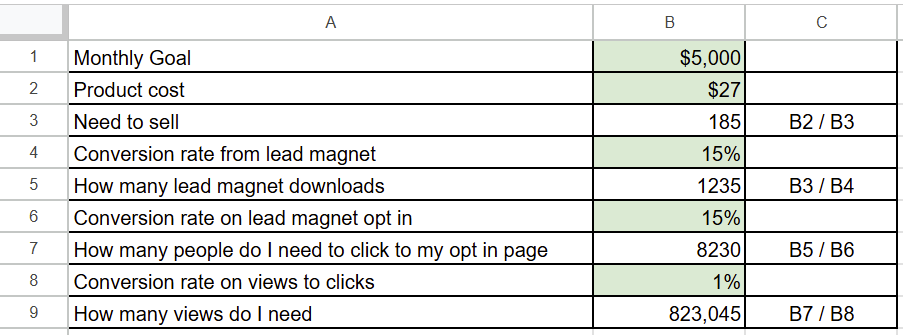
Look at that final number.
If it’s 3-5x your current traffic, you’ve got work to do but it’s achievable.
If it’s 20-50x your current traffic, something fundamental has to change.
Then ask yourself: which variable gives me the biggest leverage?
Could I raise my price and still convert enough buyers to make more revenue than I do now?
Could I add an order bump that a meaningful percentage of buyers take?
Could I create an upsell?
Could I improve my opt-in page conversion rate?
Each of those changes the entire equation. Most of them are easier than trying to multiply your audience.
The Real Work Starts Here
I get it. Looking at those numbers can feel hopeless.
Most of us don’t ever do this math because we already know it’s going to feel overwhelming. We’d rather just keep posting, keep hoping, keep telling ourselves it’ll click eventually.
But here’s the truth: you’ll spend months, years hoping for it to work, but hope is not a strategy. Clear-eyed math and a plan is a strategy.
Most solopreneurs have a revenue goal but they’ve never translated it into actual inputs. So they post more, add platforms, buy courses, hustle harder... while the fundamental math stays broken.
Run this calculation. Look at the gap honestly.
Then decide: do I commit to the traffic growth required, or do I change the model?
Sometimes the answer is yes, go build that audience.
But more often, the answer is: I need a better offer, a higher price point, or a smarter funnel.
The math doesn’t lie.
Your business model either works or it doesn’t.
Better to know now than after another year of hoping something clicks.
Hit reply or leave a comment and tell me: what did your calculation reveal?